Blog

  • Mobile Commerce Stats 2026: Revenue Shift from Web to App

    Mobile Commerce Stats 2026: Revenue Shift from Web to App

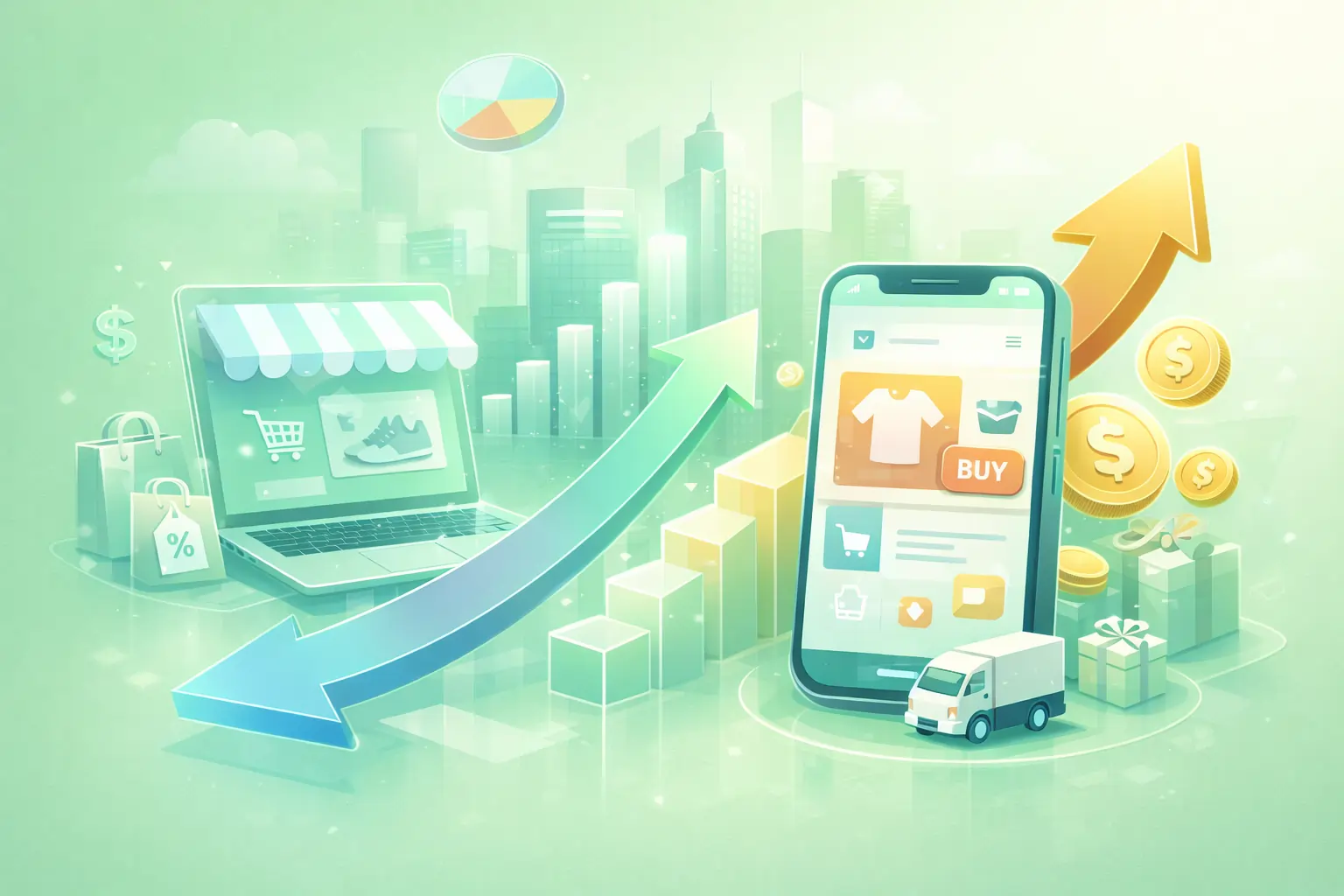
    In 2026, the center of digital shopping has quietly moved from the browser to the palm of the hand.

    Mobile traffic may still begin on the web, but revenue increasingly ends inside apps, where speed, simplicity, and personalization feel effortless.

    What once served as a supporting channel has now become the main stage for modern commerce.

    The shift is driven by experience. Native apps powered by ecosystems from Apple and Google and perfected by retail leaders like Amazon offer one-tap checkouts, smart recommendations, and instant engagement that mobile websites struggle to match.

    Shoppers stay longer, browse deeper, and buy faster, turning convenience into conversions.

    For businesses, this isn’t just a trend; it’s a revenue realignment. Understanding the mobile commerce statistics behind the web-to-app migration reveals where customers truly spend and where growth now lives.

    In an app-first world, the brands that adapt quickly are the ones that capture the future of mCommerce.

    Mobile Commerce Market Overview

    Mobile commerce (m-commerce) refers to online buying, selling, and payment activities conducted through smartphones and tablets.

    It has evolved from being a subset of traditional e-commerce into a primary digital retail channel, driven by widespread smartphone adoption, faster mobile internet, and seamless payment technologies.

    Today, many consumers prefer completing purchases directly from mobile apps rather than desktop websites, making mobile the dominant touchpoint across retail, travel, entertainment, and financial services.

    i. Market size and growth

    Current market position

    Mobile commerce now accounts for more than half of global e-commerce transactions.

    Retailers report that the majority of traffic and a growing share of conversions come from mobile devices.

    Increased app usage, improved user experience, and integrated payment systems have accelerated this shift.

    Growth outlook

    The market is expanding at a strong double-digit compound annual growth rate.

    Industry forecasts expect total transaction value to reach multiple trillions of dollars within the next decade.

    Growth is particularly strong in emerging markets where mobile phones are often the primary way people access the internet.

    ii. Key growth drivers

    Smartphone and Internet Penetration

    Affordable smartphones and broader 4G/5G coverage allow consumers to shop from anywhere at any time. In many regions, mobile devices are the first and only digital access point, which naturally supports m-commerce adoption.

    Digital payments and wallets

    Secure, one-tap payment solutions have reduced checkout friction and increased trust.

    Platforms such as Apple Pay, Google Pay, and Paytm make transactions fast and convenient, encouraging more frequent purchases.

    Changing consumer behavior

    Consumers increasingly expect instant, app-based experiences. Mobile shopping fits daily habits such as browsing on social media, watching videos, or commuting, leading to more impulse and on-the-go purchases.

    Technology advancements

    Artificial intelligence, personalization engines, and augmented reality tools help users discover products, visualize items, and receive tailored recommendations, improving conversion rates.

    iii. Major Market Trends

    App-first shopping

    Retailers prioritize dedicated mobile apps because they offer better performance, higher engagement, and stronger customer loyalty compared to mobile browsers.

    Social and in-app commerce

    Shopping features are embedded directly within social and messaging platforms, allowing users to browse and purchase without leaving the app. This shortens the buying journey and increases impulse sales.

    Wallet and QR payments

    Contactless payments and QR code transactions are becoming standard, especially in Asia-Pacific markets where mobile wallets dominate everyday purchases.

    Personalization

    Data analytics and AI provide customized offers, product suggestions, and dynamic pricing, creating more relevant shopping experiences.

    iv. Challenges

    User experience constraints

    Small screens and varying device types make it harder to design intuitive interfaces. Poor navigation or slow loading times often lead to cart abandonment.

    Security and Privacy

    As mobile transactions increase, so do concerns about fraud, data breaches, and payment security. Businesses must invest heavily in encryption and authentication technologies.

    Competition and Customer Retention

    With many apps competing for attention, maintaining engagement and loyalty requires continuous innovation and strong customer experiences.

    v. Regional insights

    Asia-Pacific

    This region leads global adoption due to strong digital payment ecosystems and super-app platforms that combine shopping, banking, and services within a single app.

    North America and Europe

    These markets show steady growth supported by established retail brands, high smartphone penetration, and advanced logistics networks.

    Emerging Markets

    Regions in Latin America, Africa, and Southeast Asia are experiencing rapid expansion as mobile devices enable first-time online shoppers.

    Traffic vs Revenue: The Growing Gap

    The traffic–revenue gap in mobile commerce is not just a device issue; it reflects a broader shift in how consumers discover, evaluate, and purchase products across digital channels.

    Mobile has become the primary gateway to shopping, but revenue realization still depends on multiple factors such as user intent, experience quality, trust, and purchasing context.

    In simple terms, mobile dominates attention, while revenue still concentrates where buying feels easiest.

    Holistic Comparison of Traffic and Revenue

    Role in the customer journey

    StageMobile’s RoleDesktop’s Role
    DiscoverySocial media, ads, browsingLimited
    ResearchReviews, comparisons, searchModerate
    EvaluationShort sessions, multitaskingFocused sessions
    CheckoutOften abandoned or delayedFrequently completed
    Order valueSmaller, impulse buysLarger, planned purchases

    This shows that mobile often starts the journey, while desktop often finishes it.

    Behavioral differences

    Mobile behavior

    Mobile shopping tends to be quick and fragmented. Users browse during commutes, breaks, or while multitasking.

    Sessions are shorter, attention is divided, and purchases are often impulsive or postponed.

    Mobile is strongly linked with discovery through platforms like Instagram and TikTok.

    Desktop behavior

    Desktop sessions are more intentional. Users sit down with time to compare options, enter details comfortably, and complete higher-value purchases. This leads to stronger conversion rates and larger cart sizes.

    Economic impact comparison

    Traffic metrics

    Mobile generates the majority of impressions, clicks, and sessions. Marketing campaigns therefore appear highly successful on mobile in terms of reach and engagement.

    Revenue metrics

    Desktop often delivers:

    • Higher conversion rates
    • Higher average order values
    • Lower abandonment rates

    This creates a situation where fewer visitors generate more money.

    Cost implications

    Because brands pay for traffic acquisition (ads, promotions, SEO), high mobile traffic with low conversion can increase customer acquisition cost and reduce profitability.

    Experience factors behind the gap

    Interface constraints

    Small screens, typing difficulty, and complex navigation create friction on mobile that does not exist on desktop.

    Payment friction

    Although solutions such as Apple Pay and Google Pay simplify checkout, not all users adopt them, leading to manual entry and drop-offs.

    Trust and perceived risk

    Consumers often feel more secure making expensive purchases on larger devices.

    Context of use

    Mobile is used everywhere; desktop is used in more stable, focused environments. Focus directly affects purchase completion.

    Strategic interpretation

    From a broader business perspective:

    • Mobile = reach, awareness, engagement
    • Desktop = efficiency, conversions, revenue

    So mobile drives the top of the funnel, while desktop strengthens the bottom of the funnel.

    Organizations that treat mobile only as a smaller version of desktop often struggle.

    Instead, mobile must be optimized for speed, simplicity, and instant checkout to capture revenue at the same moment as intent.

    Revenue Shift from Web to App (Core Statistics)

    The mobile commerce landscape is no longer just about “mobile vs desktop.” A more important shift is happening within mobile itself: revenue is steadily moving from mobile web browsers to dedicated mobile apps.

    While mobile web still brings large volumes of visitors, apps are increasingly responsible for most mobile purchases, higher conversion rates, and stronger customer lifetime value.

    In broader terms, the browser drives reach, but the app drives money.

    Mobile’s share of E-commerce

    Mobile devices now account for roughly 55–60% of total global e-commerce sales, meaning more than half of online purchases start and finish on smartphones.

    App vs mobile web

    Within mobile commerce:

    • Around 50–60% of mobile revenue comes from apps
    • Around 40–50% comes from mobile browsers

    This indicates that apps already generate more revenue than mobile web, even when they attract fewer users.

    Core performance comparison

    Traffic vs revenue vs conversion

    PlatformTraffic ShareRevenue ShareConversion Strength
    Mobile WebHighestLowestWeak
    Mobile AppModerateHighestStrongest
    DesktopModerateHighStrong

    What this shows

    Mobile web dominates visits, but apps dominate sales efficiency. Desktop remains strong for high-value purchases, but apps are closing that gap quickly.

    Key statistics that explain the shift

    Conversion rates

    Mobile apps convert 2–4× higher than mobile websites.
    If a mobile website converts about 1–2% of visitors, an app often converts 5–6% or more.

    This single factor has the biggest impact on revenue growth.

    Average order value

    Orders placed in apps are typically 10–30% larger than those on mobile web.
    Saved addresses, stored cards, and personalized offers encourage customers to buy more per transaction.

    Engagement time

    Users spend most of their mobile time inside apps, not browsers. More time spent means:

    • more product discovery
    • more repeat visits
    • more purchase opportunities

    Customer retention

    Apps enable:

    • push notifications
    • loyalty rewards
    • saved preferences
    • faster reordering

    These features increase repeat purchases and lifetime value, which mobile web struggles to match.

    Why Apps Outperform Mobile Web

    Frictionless checkout

    Apps often support one-tap payments through services like Apple Pay and Google Pay. Eliminating manual typing significantly reduces cart abandonment.

    Personalization

    Apps remember behavior and preferences, enabling tailored recommendations and offers that increase conversion probability.

    Speed and stability

    Apps load faster and feel smoother than mobile websites, reducing drop-offs caused by slow pages.

    Direct communication

    Push notifications re-engage users instantly, bringing them back to complete purchases or respond to promotions.

    Challenges of Mobile Web in 2026

    Mobile web has evolved significantly, but in 2026 it still faces structural and behavioral challenges that limit its effectiveness compared to native or modern app-based experiences.

    As user expectations rise and performance standards tighten, even small friction points can drastically affect engagement, retention, and conversions.

    Below are the most pressing challenges shaping the mobile web landscape this year.

    Performance limitations in real-world conditions

    Even with improved 5G coverage, mobile web performance is still inconsistent across regions and devices.

    Network throttling, low-end smartphones, heavy JavaScript frameworks, and third-party scripts often result in slower load times and delayed interactivity.

    Core Web Vitals remain critical, yet many websites struggle with Largest Contentful Paint (LCP) and Interaction to Next Paint (INP).

    In competitive markets, a delay of even one second can significantly increase bounce rates.

    Limited access to device capabilities

    Mobile browsers still cannot fully leverage device-level features the way native apps can.

    Access to advanced sensors, background processes, deep hardware integrations, and certain APIs remains restricted or inconsistent across browsers.

    While Progressive Web Apps (PWAs) have narrowed the gap, browser fragmentation and platform restrictions, especially between iOS and Android ecosystems—continue to limit full parity with native functionality.

    Weaker user retention and engagement

    Unlike apps that live on a user’s home screen, mobile websites rely heavily on repeat discovery through search, ads, or direct URL entry.

    There is no guaranteed presence or persistent notification channel unless users opt in.

    Push notifications via browsers exist but adoption and permission rates remain lower compared to native apps. This makes lifecycle marketing and long-term engagement more challenging for mobile-first businesses.

    UX friction and conversion drop-offs

    Mobile web still struggles with micro-frictions: autofill inconsistencies, payment redirects, session timeouts, pop-up interference, and form fatigue.

    Checkout processes are often longer and less optimized than in-app experiences.

    Additionally, mobile browsers handle complex flows like onboarding, authentication, and multi-step purchases with more risk of abandonment due to tab switching and memory limitations.

    Browser and platform fragmentation

    Developers must optimize for multiple browsers such as Google Chrome, Safari, Mozilla Firefox, and Samsung Internet, each with different rendering engines and API support.

    In 2026, cross-browser compatibility is still not perfect. Certain PWA features, storage limits, background sync capabilities, and push notification behaviors vary significantly, especially on iOS devices.

    Security and privacy constraints

    Stricter privacy regulations and browser-level tracking prevention systems reduce marketers’ ability to track user behavior effectively.

    Third-party cookie deprecation and enhanced privacy controls make attribution modeling more complex.

    While this shift is positive for user privacy, it forces businesses to rethink personalization, retargeting, and performance measurement strategies on mobile web platforms.

    Monetization and app-like competition

    The biggest strategic challenge is competition from modern app solutions.

    Super apps, lightweight native apps, and hybrid solutions offer smoother experiences, faster load times, and better personalization.

    Mobile users increasingly expect app-level performance everywhere. When a mobile website fails to deliver instant responsiveness and seamless navigation, users are quick to switch to competitors offering app-first experiences.

    Business Strategy: Moving to App-First Commerce

    In 2026, app-first commerce is no longer just a tech upgrade rather it’s a strategic shift in how businesses acquire, engage, and retain customers.

    As consumer behavior increasingly favors app-based interactions, brands are restructuring their digital ecosystems around mobile applications rather than traditional websites.

    Here’s how modern businesses are building and executing an app-first strategy.

    1. Understanding the shift in consumer behavior

    Consumers now expect instant loading, seamless navigation, and personalized experiences.

    Native and hybrid apps outperform mobile web in speed, offline capabilities, and frictionless checkout flows.

    Platforms like Amazon and Shein have trained users to expect AI-driven recommendations, one-click purchasing, and persistent shopping carts.

    This behavioral shift is pushing mid-size and even small businesses to rethink their digital foundation.

    2. Building owned distribution channels

    App-first commerce reduces dependence on third-party platforms and volatile ad algorithms.

    Instead of constantly reacquiring traffic, brands focus on building a retained user base with home-screen presence.

    Push notifications, in-app messaging, and loyalty integrations allow businesses to control communication directly.

    Unlike email or social media, app notifications achieve significantly higher engagement rates when used strategically.

    3. Designing frictionless in-app conversion flows

    One of the strongest advantages of app-first commerce is reduced checkout friction. Saved payment details, biometric authentication, and persistent sessions streamline purchasing.

    Technologies such as Apple Pay and Google Pay enable secure one-tap transactions, dramatically lowering cart abandonment compared to mobile web redirects.

    Leveraging data for deeper personalization

    Apps generate richer behavioral data than mobile websites. Session tracking, browsing patterns, repeat purchase cycles, and engagement frequency can be analyzed in real time.

    With proper analytics infrastructure, businesses can create hyper-personalized recommendations, time-sensitive offers, and behavior-triggered campaigns.

    This transforms the app from a simple shopping tool into a growth engine.

    Strengthening retention through loyalty ecosystems

    App-first brands embed loyalty programs directly into the user experience.

    Points, rewards, exclusive access, and gamified engagement are seamlessly integrated into the app interface.

    Companies like Starbucks demonstrate how loyalty-driven apps can significantly increase purchase frequency and customer lifetime value through rewards automation and personalized promotions.

    Operational considerations and infrastructure

    Moving to app-first commerce requires backend readiness. Businesses must align inventory management, CRM systems, payment gateways, and customer support tools to support real-time synchronization.

    Cloud-based solutions, API-driven architecture, and scalable microservices make it easier to maintain performance as user demand grows.

    Without this infrastructure alignment, even the best-designed app will struggle under traffic spikes.

    Balancing web and app ecosystems

    App-first does not mean web abandonment. Instead, the website becomes an acquisition and discovery channel, while the app becomes the primary engagement and conversion hub.

    Search engines still drive awareness. However, smart brands encourage users to transition from mobile web to app environments through incentives, exclusive features, and improved user experience.

    Future Outlook (2027 and Beyond

    As we move beyond 2026, digital commerce and mobile experiences are entering a phase where speed, intelligence, and ecosystem integration define success.

    The competition will no longer be between web and app alone. It will be between static platforms and adaptive, AI driven ecosystems.

    Here is what 2027 and the years ahead are likely to reshape.

    AI native app experiences become standard

    Artificial intelligence will shift from being a feature to becoming the foundation of user experience.

    Apps will predict intent, pre load relevant content, and personalize interfaces dynamically based on behavior patterns.

    Companies like Amazon are already leveraging predictive recommendations, but future systems will go further by adjusting pricing, offers, and navigation layouts in real time. Personalization will feel invisible yet deeply intuitive.

    Rise of super apps and ecosystem consolidation

    Inspired by platforms such as WeChat and Grab, more regions will move toward super app ecosystems.

    Instead of downloading multiple apps, users will rely on multifunctional platforms that combine shopping, payments, messaging, and services.

    This will force businesses to choose between building standalone brand apps or integrating into dominant ecosystems for visibility and scale.

    Seamless voice and conversational commerce

    Voice assistants and conversational interfaces will mature significantly.

    Platforms like Google Assistant and Siri are expected to integrate deeper into commerce workflows.

    Search, product discovery, and reordering may increasingly happen through natural language commands rather than typed queries.

    Businesses will need to optimize for voice intent and conversational UX, not just visual interfaces.

    Augmented reality and immersive shopping

    AR shopping experiences will become lighter, faster, and more accessible.

    Trying products virtually from furniture to cosmetics will shift from novelty to expectation.

    Retail innovators such as IKEA have already experimented with AR visualization.

    By 2027 and beyond, immersive previews may become a default feature for high consideration purchases.

    Hyper personalized loyalty ecosystems

    Future commerce will focus less on transactions and more on lifecycle ecosystems.

    Apps will integrate subscription models, community features, gamification, and AI driven rewards.

    Brands that successfully create emotional and habitual engagement similar to how Starbucks built loyalty through app rewards will outperform those relying purely on discounts.

    Privacy first infrastructure and first party data

    As privacy regulations strengthen globally, businesses will rely more on consent driven, first party data ecosystems.

    Apps will become central data hubs, replacing traditional cookie based tracking systems.

    Transparent value exchange where users clearly understand what data is collected and why will become a competitive advantage rather than just a compliance obligation.

    The narrowing gap between native, hybrid, and web

    Technological advancements will blur the boundaries between native apps, hybrid frameworks, and advanced Progressive Web Apps.

    Performance differences will shrink, but strategic differences in retention, distribution, and ecosystem control will remain.

    The winners in 2027 and beyond will not be those who simply build an app. They will be those who build intelligent, adaptive, and scalable digital ecosystems.

    The future of commerce is not platform specific. It is experience specific.

    Businesses that prioritize speed, personalization, ecosystem thinking, and long term user relationships will define the next generation of digital growth.

    Conclusion: Mobile Commerce Stats

    In 2026, the real shift in mobile commerce is not happening on screens. It is happening in habits. Consumers are no longer browsing their way to purchases. They are returning to ecosystems that already know them, remember them, and anticipate them.

    The revenue movement from web to app is not a trend spike. It is a behavioral realignment.

    The mobile web opened the door to digital shopping. Apps are now building the house.

    With faster journeys, smarter recommendations, and frictionless payments, apps have become the natural destination for high intent buyers.

    Businesses that still treat apps as optional are competing for traffic. Brands that embrace app first thinking are building relationships.

    The numbers of 2026 tell a clear story. Revenue follows convenience. Loyalty follows experience.

    And the future of mobile commerce belongs to platforms that live in the palm of the customer, not just in the search results.

  • Traditional App Development vs Modern Solutions

    Traditional App Development vs Modern Solutions

    Traditional app development has long been the standard approach for building software, but it often involves heavy coding, complex infrastructure, and lengthy development cycles.

    Even simple applications can take significant time and resources to complete, making the process slow and demanding for both developers and businesses.

    As user expectations continue to grow, these challenges become more noticeable. Delays in updates, high maintenance costs, and difficulty scaling systems can limit innovation and reduce competitiveness.

    Relying solely on traditional methods can make it harder for organizations to adapt to change.

    Modern solutions offer a more flexible and efficient way forward. With cloud-based tools, low-code platforms, and automated workflows, teams can build and deploy applications faster while focusing on solving real problems.

    This shift helps businesses stay agile, productive, and ready for the future.

    Overview of Traditional App Development

    Traditional App Development vs Modern Solutions

    Traditional app development is the process of building applications specifically for a particular platform, such as Android, iOS, or Windows, using that platform’s native programming languages and tools.

    Each app is created to run directly on the operating system it is designed for, ensuring better compatibility and performance.

    In this approach, developers usually create separate codebases for different platforms. For example, one version of the app is built for Android and another for iOS. This allows the app to fully follow platform guidelines and access device features like the camera, GPS, and sensors more efficiently.

    Although traditional development provides high speed, reliability, and a smooth user experience, it requires more time, cost, and maintenance because multiple versions must be developed and updated separately.

    It is best suited for apps that need strong performance and deep system integration.

    Limitations of Traditional App Development

    Traditional App Development vs Modern Solutions

    1. Platform fragmentation

    Traditional app development often requires separate applications for different ecosystems such as iOS and Android.

    Because companies like Apple and Google use different programming languages, development tools, and design standards, code cannot easily be shared across platforms.

    This leads to multiple codebases and increases complexity for development teams.

    2. Higher development cost

    Creating and maintaining separate versions of the same application increases expenses. Teams must invest more in specialized developers, testing processes, and ongoing support.

    Even small updates or changes can require repeating the same work, which adds to the overall budget.

    3. Slower time to market

    Each feature must be designed, built, and tested independently for every platform.

    This slows down the release cycle and makes it harder for businesses to respond quickly to market trends or customer feedback.

    4. Maintenance overhead

    Maintaining multiple versions of an application over time can be challenging.

    Bug fixes, security patches, and system updates need to be implemented separately for each platform, increasing workload and the risk of inconsistencies between versions.

    Modern App Development Solutions

    Traditional App Development vs Modern Solutions

    Modern app development is no longer just about building software but it’s about creating scalable, high-performance digital experiences across devices and platforms.

    Businesses today must choose the right development approach to balance speed, cost, user experience, and long-term growth.

    i. Native app development

    Native app development focuses on building applications specifically for platforms like iOS and Android using platform-specific languages and tools.

    For iOS, developers typically use Swift, while Android apps are built with Kotlin or Java, React, or Node.js. Because native apps are designed for a single ecosystem, they offer superior performance, smoother animations, and seamless integration with device features like GPS, camera, and biometric authentication.

    This approach is ideal for businesses that prioritize speed, reliability, and high-end user experience. While development and maintenance costs may be higher due to separate codebases, the payoff often comes in performance optimization and deeper platform compatibility.

    ii. Cross-platform app development

    Cross-platform development allows developers to write one codebase and deploy it across multiple platforms. Frameworks like Flutter and React Native make this possible by bridging native components with shared code.

    This significantly reduces development time and cost while maintaining near-native performance.

    For startups and growing businesses, cross-platform solutions provide a strategic advantage. You can launch faster, test your market efficiently, and iterate without maintaining two entirely separate teams.

    Although there can be slight performance trade-offs compared to fully native apps, modern frameworks have minimized these gaps substantially.

    iii. Progressive web apps (PWAs)

    Progressive Web Apps combine the reach of the web with the functionality of mobile apps. Built using standard web technologies, PWAs can be installed on a device, work offline, and send push notifications without requiring traditional app store distribution.

    PWAs are cost-effective and highly scalable, making them attractive for businesses focused on accessibility and global reach.

    While they may not access every advanced hardware feature like native apps, they deliver impressive performance and user experience for content-driven platforms and ecommerce solutions.

    iv. Hybrid app development

    Hybrid app development combines elements of both native and web applications. These apps are essentially web applications wrapped in a native container, enabling them to be distributed through app stores while using web technologies like HTML, CSS, and JavaScript.

    Hybrid solutions are practical for businesses seeking affordability and faster deployment. However, performance can vary depending on the complexity of the application and how intensively it uses device features.

    For simpler applications and MVP launches, hybrid development remains a viable and strategic option.

    v. Cloud-based and backend-as-a-service (BaaS) solutions

    Modern app development increasingly relies on cloud infrastructure and Backend-as-a-Service platforms.

    Solutions like Firebase allow developers to integrate authentication, real-time databases, analytics, and push notifications without managing physical servers.

    Cloud-based architecture ensures scalability, security, and global performance optimization. It enables businesses to focus on user experience and feature innovation while infrastructure management remains automated and flexible.

    This approach is especially beneficial for startups, SaaS platforms, and rapidly scaling applications.

    Advantages of Modern Solutions

    Modern development solutions are designed to meet the demands of speed, scalability, and evolving user expectations.

    Businesses adopting these solutions gain both technical flexibility and long-term competitive advantages.

    Faster time to market

    Modern frameworks and development methodologies significantly reduce the time required to build and launch applications.

    With reusable components, cloud services, and cross-platform tools, teams can streamline workflows and accelerate production cycles.

    This speed enables businesses to test ideas quickly, gather user feedback, and iterate efficiently.

    In competitive markets, faster time to market often determines whether a product leads or follows.

    Scalability and flexibility

    Modern solutions are built with scalability in mind, often leveraging cloud platforms and microservices architecture.

    Services like Firebase allow applications to handle increasing traffic without performance degradation.

    This flexibility ensures that as your user base grows, your system can adapt without requiring a complete rebuild.

    Businesses can scale resources dynamically, optimizing both performance and cost efficiency.

    Improved user experience

    Modern development frameworks focus heavily on performance optimization and UI consistency.

    Technologies such as Flutter and React Native help deliver smooth animations, responsive layouts, and native-like interactions.

    A better user experience leads to higher engagement, improved retention rates, and stronger brand loyalty.

    Performance and design quality directly influence user perception and satisfaction.

    Cost efficiency

    Cross-platform and cloud-based solutions reduce the need for separate development teams and infrastructure investments.

    By maintaining a single codebase for multiple platforms, businesses can significantly lower development and maintenance costs.

    Additionally, cloud infrastructure minimizes hardware expenses and operational overhead.

    This cost efficiency allows companies to allocate more resources toward innovation and marketing.

    Enhanced security and maintenance

    Modern solutions integrate advanced security protocols, automatic updates, and managed backend services.

    Regular patches and cloud monitoring tools help protect applications against vulnerabilities and data breaches.

    Maintenance also becomes more streamlined, as updates can be deployed centrally without disrupting user experience.

    This ensures long-term stability, reliability, and trust in your digital product.

    A Comparison: Traditional App Development vs Modern Solutions

    Digital transformation has reshaped how applications are built, deployed, and maintained.

    Understanding the direct differences between traditional and modern development approaches helps businesses choose the right strategy for growth and innovation.

    1. Development approach

    Traditional development typically follows the Waterfall model, where planning, design, development, testing, and deployment occur in strict sequential phases.

    Changes late in the process can be costly and time-consuming, making flexibility limited once the project is underway.

    Modern development embraces Agile and DevOps methodologies. Instead of long release cycles, teams work in short sprints with continuous integration and deployment.

    This enables faster iteration, real-time feedback, and quicker product improvements.

    2. Infrastructure and hosting

    Traditional systems often rely on on-premise servers and manual infrastructure management.

    Businesses must invest heavily in hardware, maintenance, and IT teams to ensure uptime and security.

    Modern solutions leverage cloud-based infrastructure such as Amazon Web Services and Microsoft Azure.

    These platforms provide scalable, pay-as-you-go resources that grow with demand, reducing upfront investment and operational complexity.

    3. Performance and user experience

    Traditional applications often prioritize functionality over design and responsiveness.

    User interfaces may feel outdated, and performance can decline as systems age without optimization.

    Modern applications are built with user experience at the core. Frameworks like Flutter and React Native help deliver smooth animations, responsive layouts, and consistent cross-device performance, resulting in higher engagement and satisfaction.

    4. Scalability and maintenance

    Traditional systems can struggle with scalability, often requiring significant restructuring to handle increased traffic or new features.

    Maintenance typically involves manual updates, downtime, and higher operational risk.

    Modern architectures use microservices, automation, and cloud scaling to handle growth dynamically.

    Updates can be rolled out seamlessly, minimizing disruption and ensuring long-term system stability.

    5. Cost structure

    Traditional development often requires large upfront capital investments in hardware, licenses, and dedicated teams.

    Long development cycles also increase labor costs and delay revenue generation.

    Modern solutions typically follow a subscription or usage-based model.

    Cloud services, cross-platform frameworks, and managed backends reduce infrastructure costs and improve return on investment by accelerating time to market and optimizing ongoing expenses.

    Future Trends in App Development

    Traditional App Development vs Modern Solutions

    The future of app development is being shaped by rapid technological innovation, evolving user behavior, and the demand for faster, smarter digital experiences.

    Businesses that adapt to these emerging trends will gain a significant competitive advantage in performance, scalability, and user engagement.

    AI-powered applications

    Artificial Intelligence is becoming a core component of modern applications.

    From personalized recommendations to smart chatbots and predictive analytics, AI enhances automation and decision-making within apps.

    Technologies like TensorFlow enable developers to integrate machine learning capabilities directly into mobile and web applications.

    In the future, AI-driven apps will deliver hyper-personalized user experiences, automate workflows, and improve customer engagement at scale.

    5G-enabled experiences

    With the global rollout of 5G networks, app performance and connectivity will reach new levels.

    Faster speeds and lower latency will allow developers to create more immersive applications, including AR, VR, and real-time cloud gaming.

    5G will reduce buffering, enhance video quality, and improve real-time communication features.

    This advancement will open doors to data-intensive experiences that were previously limited by network constraints.

    Super apps and ecosystem integration

    Super apps combine multiple services into a single platform, offering users convenience and seamless integration.

    A strong example is WeChat, which integrates messaging, payments, social networking, and more within one ecosystem.

    This trend encourages businesses to build interconnected platforms rather than standalone apps.

    Future development will focus on creating unified digital ecosystems that centralize user needs in one application.

    Low-code and no-code development

    Low-code and no-code platforms are transforming how applications are built.

    These solutions allow businesses to create functional apps using visual builders with minimal manual coding.

    Platforms like OutSystems empower teams to accelerate development cycles and reduce reliance on extensive engineering resources.

    This democratization of development will continue to grow, enabling faster innovation and experimentation.

    Enhanced app security and privacy

    As cyber threats evolve, app security will remain a top priority. Future applications will incorporate stronger encryption, biometric authentication, and zero-trust security frameworks.

    Privacy-focused development will also increase, with stricter data regulations shaping how apps collect and store user information.

    Businesses that prioritize transparent data practices and robust security measures will build stronger trust with their users and maintain regulatory compliance.

    Conclusion

    Traditional app development often presents a significant financial barrier due to high upfront costs, longer development cycles, separate platform teams, and ongoing infrastructure maintenance.

    These rigid models can slow innovation and tie up valuable capital, making it difficult for startups and growing businesses to compete in fast-moving digital markets.

    Modern solutions, on the other hand, reduce this cost pressure through cloud infrastructure, cross-platform frameworks, and scalable backend services.

    By lowering initial investment, accelerating time to market, and enabling flexible scaling, modern development approaches transform app creation from a heavy financial burden into a strategic growth opportunity.

  • Small Business App Gap: Why 92% Don’t Have Mobile Apps in 2026

    Small Business App Gap: Why 92% Don’t Have Mobile Apps in 2026

    In 2026, mobile apps drive how customers shop, book services, and connect with brands.

    From ordering food to managing appointments and making payments, most daily interactions now happen inside apps rather than websites.

    For businesses, a mobile presence is no longer optional but a key part of staying visible and competitive.

    Yet despite this shift, nearly 92 percent of small businesses still do not have a dedicated mobile app.

    Many rely only on websites or social media, missing out on tools like push notifications, loyalty features, and personalized experiences that apps make possible.

    This disconnect has created what experts call the Small Business App Gap.

    High development costs, limited technical skills, and uncertainty about return on investment continue to hold small businesses back.

    As customers increasingly expect fast and seamless mobile experiences, closing this gap has become essential for growth, customer retention, and long-term success.

    In this blog post, we’ll explore why so many small businesses lack mobile apps, the challenges they face, and the opportunities they can grab by embracing mobile-first strategies.

    The Rise of the Mobile-First Economy

    Smartphones now connect most of the world’s population to the internet, with over 5.78 billion people using a smartphone in 2026, representing more than 70% global penetration of all people on Earth. This growth builds on rapid expansion of 5G and mobile infrastructure, making mobile devices central to everyday digital life.

    People spend a large amount of their digital time inside apps rather than on mobile browsers. Recent industry data shows that users spend around 4.5 to 5 hours per day inside mobile apps, and roughly 88% of mobile time is spent in apps not web browsers, illustrating how dominant apps are for consuming content, shopping, messaging, entertainment, and services.

    Mobile commerce and app usage have also grown strongly. For example, e-commerce apps are used by 75% of consumers globally each month, and mobile commerce is projected to account for a majority of online retail sales.

    This data shows that apps are not just tools for socializing or entertainment rather they are where users increasingly make purchases, find services, and interact with businesses.

    Because of these shifts in behavior and technology, mobile apps have become the preferred way for people to access digital services, and companies that prioritize strong mobile experiences tend to engage users more effectively.

    For small businesses especially, ignoring this mobile first trend risks missing out on how customers now search, shop, buy, and stay loyal.

    What Is the Small Business App Gap

    The small business app gap refers to the large disparity between consumer expectations for mobile engagement and the actual mobile presence of small businesses.

    Despite the rise of mobile commerce, surveys show that about 92% of small businesses globally still do not have a dedicated mobile app in 2026.

    This means that the vast majority of small enterprises rely solely on websites or social media platforms to reach customers, missing out on app-driven features like push notifications, loyalty programs, and faster, personalized user experiences.

    The gap is particularly striking when compared with larger companies. While enterprises invest heavily in mobile apps, customer analytics, and app marketing, most small businesses have limited resources, technical expertise, or confidence in the return on investment from a mobile app.

    This creates a competitive disadvantage, as apps increasingly become the primary channel for discovery, transactions, and customer engagement.

    Research also shows that small businesses without apps tend to have lower customer retention rates and miss opportunities to leverage mobile commerce trends.

    With mobile e-commerce projected to account for over 60% of online sales by 2026, the small business app gap highlights not just a technological lag but a critical strategic challenge for small enterprises in today’s mobile-first economy.

    Why Most Small Businesses Do Not Have Mobile Apps

    Small businesses face growing pressure to adopt mobile technology as consumers increasingly prefer app-based interactions.

    Yet despite the clear benefits, most small businesses struggle to launch or maintain a dedicated mobile app.

    1. High development and maintenance costs

    Developing a mobile app requires significant investment, including design, coding, testing, and ongoing updates. For small businesses with limited budgets, these costs can feel overwhelming.

    Many small business owners prioritize immediate operational expenses over long-term technology projects. As a result, app development is often postponed or abandoned entirely.

    Even after an app is launched, maintenance, bug fixes, and platform updates add recurring costs. These ongoing financial demands can discourage small businesses from pursuing a mobile presence.

    2. Limited technical skills

    Building and managing a mobile app requires technical expertise that many small businesses do not have. Without IT staff or developer support, app development can seem intimidating or unmanageable.

    Owners may also struggle to choose the right platform, features, or integration options for their business, leading to uncertainty about the app’s functionality and value.

    This lack of technical confidence often causes businesses to rely solely on websites or social media instead of creating a dedicated mobile experience.

    3. Time constraints and operational priorities

    Running a small business involves juggling multiple responsibilities, from managing staff and inventory to handling marketing and customer service.

    Adding app development to an already full schedule can feel impossible, even if the potential benefits are clear.

    As a result, many owners delay or avoid mobile app projects, focusing instead on day-to-day operations and immediate revenue-generating activities.

    4. Uncertain return on investment

    Small businesses may hesitate to invest in a mobile app because the financial payoff is unclear.

    Without experience or data on customer behavior, the benefits of an app, such as higher engagement or repeat sales, can seem speculative.

    This uncertainty makes it difficult for owners to justify the time, effort, and money required to launch and maintain a mobile app.

    5. Belief that websites or social media are enough

    Many small businesses assume that a website or social media presence is sufficient to reach their customers.

    They often underestimate how apps offer faster, personalized, and more convenient interactions that drive engagement and loyalty.

    Relying solely on traditional digital channels can leave businesses behind competitors that provide app-based experiences.

    What Small Businesses Are Missing Without an App

    Even without an app, small businesses continue to operate, but they miss significant opportunities to engage and retain customers. A dedicated mobile app can offer features and convenience that websites or social media alone cannot provide.

    Enhanced customer engagement

    Mobile apps allow businesses to communicate directly with customers through push notifications, personalized offers, and reminders.

    Without an app, businesses rely on email or social media, which may not reach users instantly or get the same level of attention.

    This limited engagement can reduce brand loyalty and make it harder to keep customers returning for repeat purchases.

    Faster and smoother user experience

    Apps provide streamlined interfaces and faster performance compared to mobile websites.

    Customers can browse products, book services, or make payments with fewer steps, improving satisfaction and reducing friction.

    Without an app, businesses risk losing customers to competitors who provide a more convenient and efficient mobile experience.

    Improved customer retention and loyalty

    Apps often include loyalty programs, rewards, and personalized recommendations that encourage repeat purchases.

    Without these tools, small businesses miss opportunities to strengthen relationships with existing customers.

    This can result in lower repeat sales, reduced lifetime customer value, and weaker competitive positioning.

    Access to mobile commerce

    Mobile apps are increasingly the primary channel for shopping, ordering, and transactions.

    Businesses without apps may struggle to capture sales from customers who prefer in-app purchasing or mobile payments.

    By not having a presence on mobile devices, small businesses risk missing a growing share of revenue in a mobile-first economy.

    Competitive disadvantage

    Competitors with apps can offer faster, personalized, and more engaging experiences.

    Customers are more likely to favor businesses that make interactions easy and convenient through mobile apps.

    Without an app, small businesses risk falling behind in visibility, loyalty, and long-term growth.

    New Solution Lowering the Barrier to Entry

    Traditional app development can be expensive, time-consuming, and technically complex.

    No-code native app builders are changing the landscape, making mobile apps accessible to small businesses without coding expertise.

    1. No-code native app builders simplify development

    No-code app platforms allow small business owners to create fully functional mobile apps using visual editors and drag-and-drop tools.

    Users can design interfaces, add features, and configure workflows without writing a single line of code.

    This makes app development faster, more affordable, and accessible to anyone, even without technical experience.

    2. Affordable and scalable solutions

    No-code native app builders often use subscription-based pricing, which eliminates the need for large upfront investments.

    Small businesses can start with basic features and scale their apps as their needs grow, adding new functionality over time.

    This flexibility allows owners to experiment with mobile apps without risking excessive costs or long-term commitments.

    3. Quick deployment and easy maintenance

    Apps built on no-code platforms can be launched quickly to both iOS and Android stores, reducing the time it takes to reach customers.

    Ongoing updates and maintenance are simplified through platform dashboards, which often automate updates and bug fixes.

    This reduces the technical burden on small business owners and ensures apps remain functional and up to date with minimal effort.

    How Small Businesses Can Get Started

    Launching a mobile app may seem intimidating for small businesses, but breaking the process into clear steps can make it manageable. With the rise of no-code app builders, even businesses without technical expertise can create and deploy apps efficiently.

    Assess business needs and goals

    Before creating an app, owners should identify the main objectives, such as increasing sales, improving customer engagement, or offering loyalty programs.

    Understanding what features are most valuable helps prioritize functionality and avoid overcomplicating the app.

    A clear plan ensures the app aligns with business goals and maximizes the return on time and investment.

    Choose the right platform and tools

    Small businesses should select a platform that matches their technical skills and target audience, often using no-code native app builders for simplicity.

    These platforms allow apps to be published on both iOS and Android, reaching the largest possible customer base.

    Selecting the right tools also ensures scalability, so features can be added or updated as the business grows.

    Plan, launch, and optimize

    Even with a simple app, businesses should plan for testing, launch, and post-launch improvements.

    Gathering customer feedback after launch helps identify usability issues, bugs, or features that could increase engagement.

    Ongoing optimization ensures the app remains relevant, functional, and continues to support growth and customer satisfaction.

    Conclusion

    While mobile apps have become central to customer engagement, loyalty, and commerce, the majority of small enterprises still lack a dedicated app. High costs, limited technical skills, and uncertainty about returns continue to slow adoption.

    Yet the gap also presents a clear opportunity. No-code native app builders and simplified development tools make it easier than ever for small businesses to launch mobile apps quickly and affordably.

    By embracing mobile first strategies, businesses can improve customer experience, increase retention, and compete more effectively in an app driven market.


  • The Mobile-First Reality: 85% of Consumers Prefer Apps Over Mobile Websites

    The Mobile-First Reality: 85% of Consumers Prefer Apps Over Mobile Websites

    Mobile has taken over and apps are leading the charge.

    Today, 85% of consumers prefer mobile apps over websites, choosing faster load times, smoother navigation, and more reliable performance over clunky browser experiences.

    Apps deliver what users actually want: instant access, personalized content, offline functionality, and a frictionless journey that keeps them coming back.

    The result? Higher engagement, stronger loyalty, and more conversions.

    If your business is still betting on mobile web alone, it’s time to rethink your strategy. Build app-first because that’s where your customers already are.

    In this article, we break down the mobile-first reality transforming digital experiences, where apps, not websites, dominate consumer preference.

    Let’s dig deeper.

    The Rise of a Mobile-First World

    Mobile has become the default screen

    Smartphones are no longer just a convenience. They are now the primary gateway to the internet for billions of users. More than half of global web traffic comes from mobile devices, and for many people, their phone is the first and often only screen they use to browse, shop, and interact with brands.

    Desktop usage continues to decline as everyday digital tasks move to handheld devices.

    Consumer expectations have accelerated

    With constant connectivity comes higher expectations. Users want pages to load instantly, navigation to feel effortless, and transactions to be completed in seconds.

    Studies show that even a one second delay in load time can significantly increase bounce rates, meaning slow or clunky experiences quickly cost businesses potential customers. Convenience has become the baseline rather than a bonus.

    Behavior is shifting toward apps

    As mobile usage grows, preferences are clearly leaning toward apps. Around 85 percent of consumers say they prefer mobile apps over mobile websites because apps feel faster, smoother, and more reliable. Features like personalization, saved preferences, and offline access make apps easier for repeat use and daily interactions.

    Why businesses must adapt

    For businesses, this shift changes the rules entirely. Mobile can no longer be treated as an afterthought or a scaled-down version of desktop.

    Brands that prioritize mobile first and increasingly app first experiences are better positioned to capture attention, strengthen loyalty, and stay competitive in a market where speed and simplicity define success.

    Why Consumer Behavior Now Favors Apps Over Browsers

    Faster and smoother user experiences

    Apps are built to run directly on a device’s operating system, which allows them to load faster and operate more smoothly than most mobile websites. They can cache data, pre-load content, and reduce server round trips.

    As a result, interactions feel instant and fluid. Since modern consumers have very little tolerance for delays, even small improvements in speed make apps more appealing than browser-based experiences.

    Deeper personalization and smarter recommendations

    Apps collect behavioral data over time, allowing them to understand user preferences in detail. This enables personalized home screens, curated recommendations, and adaptive content feeds.

    While browsers can store cookies and session data, they do not typically offer the same level of persistent personalization across interactions. Consumers increasingly expect experiences that feel tailored, and apps are better positioned to deliver that.

    Stronger engagement through push notifications

    Push notifications play a major role in why consumers favor apps. Apps can send real-time alerts about updates, messages, offers, and reminders directly to a user’s device. These notifications appear prominently and encourage immediate action.

    Although browsers can send notifications, they are more limited and less impactful. Apps maintain continuous engagement even when they are not actively open.

    Offline access and reliability

    Many apps allow users to access saved content and essential features without an active internet connection. This makes them more reliable in areas with weak connectivity.

    Browsers typically depend on consistent internet access, which can create friction. The ability to function offline increases trust and convenience, especially for media consumption, productivity tools, and travel services.

    Seamless integration with device features

    Apps integrate deeply with smartphone capabilities such as camera, GPS, biometric authentication, and background processing. This allows richer functionality, including navigation services, secure payments, health tracking, and real-time messaging.

    Browsers have limited access to hardware features and cannot match the same level of system integration.

    Habit formation and ecosystem loyalty

    Once consumers download an app and invest time in setting preferences, saving information, and building usage history, they are more likely to return.

    Opening an app becomes a habitual action that requires less effort than searching through a browser. Over time, users develop loyalty to app ecosystems, reinforcing repeat engagement.

    Monetization and exclusive incentives

    Apps often provide exclusive discounts, loyalty rewards, subscription perks, and in-app purchase options. These incentives encourage users to install and continue using the app rather than accessing services through a browser.

    Businesses also design app experiences to streamline conversions, making transactions faster and simpler.

    Evolving consumer expectations

    Today’s consumers expect speed, personalization, convenience, and seamless digital experiences. Apps align closely with these expectations by offering integrated, responsive, and engaging environments.

    As mobile usage continues to dominate digital interactions, consumer behavior naturally gravitates toward platforms that minimize friction and maximize convenience, which is why apps increasingly outperform browsers in many industries.

    The Built-In Advantages That Make Apps Faster and Smoother

    Apps perform better when they fully leverage the device’s hardware and operating system.
    Native features, optimized libraries, and smart resource management all contribute to a faster, more responsive experience.

    Optimized operating system integration

    Apps built with platform-specific tools can directly use system resources such as memory, CPU, and GPU.
    This tight integration allows apps to run smoothly and reduces the chance of lag during heavy operations.

    By taking full advantage of OS-level features like background processing and system optimizations, apps can provide faster load times and better responsiveness.
    Users experience fewer crashes and smoother navigation because the app works harmoniously with the device.

    Hardware acceleration

    Built-in APIs allow apps to offload graphics, animations, and video rendering to the GPU.
    This reduces the strain on the CPU and ensures that visual transitions remain smooth.

    Animations, scrolling, and touch interactions feel more fluid because the device’s hardware is fully utilized.
    Hardware acceleration also improves battery efficiency by handling intensive tasks more intelligently.

    Pre-loaded libraries and frameworks

    Modern platforms come with optimized libraries for common tasks like networking, image handling, and data storage.
    Using these pre-built tools reduces the need for custom code, making apps lighter and faster.

    These libraries are tested and optimized for performance, helping developers avoid inefficiencies.
    As a result, apps can perform complex operations without slowing down or consuming excessive resources.

    Caching and memory management

    Apps can store frequently accessed data locally or in memory to allow instant retrieval.
    This minimizes waiting time and keeps the interface responsive even under heavy use.

    Smart memory management prevents the app from consuming too much RAM, which reduces crashes.
    Efficient caching also allows repeated tasks or views to load instantly, improving the user experience.

    Asynchronous processing

    Background tasks such as fetching data or updating content can run without interrupting the interface.
    Users can continue interacting with the app while these processes happen silently.

    This approach prevents freezing or lag during heavy operations and keeps the app responsive.
    It also allows apps to update content in real-time without disrupting the user’s flow.

    Touch and gesture optimization

    Native frameworks handle gestures like scrolling, swiping, and pinch-to-zoom more efficiently.
    This makes interactions feel natural and reduces input lag.

    By using optimized touch handling, apps respond quickly to user actions.
    Animations and transitions feel fluid, creating a smoother and more enjoyable experience.

    Smarter updates and resource management

    Apps load only the resources they need and can manage memory and battery usage efficiently.
    This prevents slowdowns and keeps the app running optimally over time.

    Automatic optimization during updates ensures that performance improvements reach users seamlessly.
    Overall, this makes the app faster, smoother, and more reliable on all devices.

    How Apps Drive Higher Engagement, Loyalty, and Conversions

    1. Driving higher engagement

    Apps excel at keeping users active because they are always accessible, personal, and interactive. Key mechanisms include:

    • Push Notifications & Alerts
      Timely, personalized messages remind users to return. Example: a fitness app sending a daily workout reminder.
    • Personalized Experiences
      Apps track user behavior and preferences to deliver relevant content, offers, or recommendations. Example: Spotify curating playlists based on listening habits.
    • Gamification
      Features like points, badges, and challenges increase user interaction. Example: Duolingo motivating daily practice with streaks.
    • Frictionless Access
      Apps open faster than mobile websites, and offline functionality allows users to engage anywhere.

    2. Building loyalty

    Loyalty comes from consistent value and emotional connection:

    • Rewards and Loyalty Programs
      Apps integrate point systems, discounts, or exclusive access. Example: Starbucks Rewards app.
    • Personal Connection
      Tailored content, reminders, and personalized messaging create a sense of recognition.
    • Regular Updates & Value
      Apps that continuously add features or content keep users invested.
    • Community Features
      Social interaction or user communities within apps increase attachment. Example: Strava or Reddit communities.

    3. Increasing conversions

    Apps convert engagement into tangible business results more effectively than websites:

    • Simplified Purchase Flows
      Stored payment info, one-tap checkout, and cart reminders reduce friction.
    • Targeted Offers
      Data-driven recommendations increase the likelihood of purchase. Example: Amazon suggesting products based on browsing history.
    • Behavioral Triggers
      Push notifications for abandoned carts or personalized promotions prompt conversions.
    • Exclusive App-Only Benefits
      Special discounts or early access incentivize users to act via the app.

    Deciding Between Mobile Web, Native Apps, and Hybrid Solutions

    A strategic mobile decision requires more than understanding definitions. You need to compare performance, cost, scalability, user experience, and long-term business impact side by side. Below is a clear, practical comparison designed to help you choose with confidence.

    1. Mobile web

    Mobile web applications run inside a browser and are accessed through a URL. They are built with standard web technologies and adapt responsively across devices.

    Mobile web offers maximum accessibility. Users do not need to install anything, which reduces friction in the acquisition stage. Updates are instant, SEO is fully supported, and development costs are typically lower because you maintain a single codebase.

    However, performance depends on browser capabilities. Access to advanced device hardware is limited, offline functionality is restricted compared to apps, and user retention tools like push notifications are not as powerful as in native apps.

    Mobile web works best for content platforms, SaaS dashboards, blogs, ecommerce stores focused on traffic acquisition, and businesses prioritizing discoverability.

    2. Native apps

    Native applications are built specifically for iOS or Android using platform-specific programming languages.

    They provide the highest performance because they interact directly with the operating system. Animations are smoother, load times are faster, and access to hardware features like GPS, camera, sensors, and background processing is seamless. Native apps also support powerful engagement tools such as push notifications and deep system integrations.

    The trade-off is cost and complexity. Separate development cycles are often required for each platform, maintenance demands more resources, and app store approvals can slow deployment.

    Native is ideal for fintech, ride-sharing, social media, gaming, health tracking, and any product where speed, security, and performance define user experience.

    3. Hybrid solutions

    Hybrid apps use a shared codebase that runs across multiple platforms. Frameworks like React Native and Flutter bridge web technologies with native components.

    They strike a balance between cost and capability. Development is faster than fully native builds, and much of the code can be reused across iOS and Android. Modern hybrid frameworks offer near-native performance for most business use cases.

    While performance has improved significantly, hybrid apps may still face limitations in highly complex graphics processing or advanced hardware interactions. Custom native modules are sometimes required.

    Hybrid is well suited for startups, MVP launches, ecommerce brands expanding to app stores, and businesses seeking efficiency without sacrificing app presence.

    Side-By-Side Comparison

    Development cost

    Mobile web is generally the most affordable because one codebase serves all users.
    Hybrid sits in the middle, offering shared code across platforms.
    Native is the most expensive due to separate development paths.

    Performance

    Native delivers the highest performance and smoothest user experience.
    Hybrid performs very well for most business applications.
    Mobile web depends on browser optimization and network speed.

    User acquisition

    Mobile web has the strongest SEO advantage and instant access via links.
    Hybrid and native rely on app store discovery and downloads.

    Access to device features

    Native provides full hardware integration.
    Hybrid offers broad access but may need plugins for advanced features.
    Mobile web has limited device capability access.

    Maintenance

    Mobile web and hybrid simplify maintenance with shared codebases.
    Native requires separate updates for each platform.

    Key Steps to Building a Successful App-First Experience

    An app-first experience is not simply about launching a mobile application. It means designing your product, workflows, and growth strategy around mobile behavior from the very beginning. In a world where users expect speed, personalization, and seamless interaction, building app-first requires clarity, discipline, and long-term thinking.

    Below are the essential steps to building a high-performing app-first ecosystem.

    Start with mobile-native user behavior

    An app-first strategy begins with understanding how users behave inside apps compared to browsers. App users expect instant load times, intuitive gestures, offline access, and minimal friction. They are less patient and more action-oriented.

    Design journeys around thumb-friendly navigation, simplified flows, and contextual interactions. Remove unnecessary steps. Every tap should move users closer to value. When your product mirrors natural mobile behavior, engagement rises significantly.

    Define a clear core value proposition

    Successful apps focus on one primary promise. Whether it is convenience, speed, savings, or community, the core benefit must be immediately clear upon first launch.

    Avoid overloading your initial version with too many features. Instead, prioritize one powerful use case and perfect it. A focused app delivers clarity, while a cluttered one creates confusion and drop-offs.

    Strong app-first products solve one main problem exceptionally well before expanding.

    Prioritize performance and speed

    Performance defines perception. Even minor delays can increase churn. App-first platforms must optimize load times, animation smoothness, and backend response speed.

    Use lightweight assets, reduce unnecessary background processes, and ensure stable API performance. Offline support, where possible, adds a significant advantage because users do not always operate on perfect networks.

    In mobile environments, speed equals trust.

    Design for retention, not just downloads

    Downloads are vanity metrics. Retention drives revenue.

    Integrate onboarding that demonstrates value within the first session. Use push notifications thoughtfully to re-engage users without overwhelming them. Personalization based on behavior makes interactions more relevant and meaningful.

    Loyal users form habits when your app consistently solves their problem with minimal friction.

    Build seamless cross-channel integration

    Even in an app-first strategy, your ecosystem should remain connected. Users may discover you via web, social media, email, or ads before installing the app.

    Ensure smooth transitions between web and app environments. Deep linking, universal links, and consistent branding across channels reduce friction and increase conversions. The experience should feel unified rather than fragmented.

    An app-first model works best when every touchpoint supports the mobile journey.

    Focus on scalable architecture

    Long-term success depends on scalability. Choose technologies that support growth in user base, feature expansion, and data processing needs.

    Plan backend infrastructure carefully. Ensure your system can handle increased traffic without performance degradation. Modular development allows you to expand features without rebuilding the entire app.

    App-first success is not about launch day. It is about sustained growth.

    Measure, iterate, and optimize continuously

    An app-first approach requires data-driven refinement. Track session duration, retention rate, churn rate, feature usage, and conversion metrics.

    Use analytics to identify friction points. A small UX improvement can dramatically impact engagement. Regular updates signal reliability and keep the experience fresh.

    Iteration is not optional. It is the foundation of mobile success.

    Final Thoughts: The Mobile-First Reality

    The fact that 85% of consumers prefer apps over mobile websites highlights the undeniable shift toward a mobile-first reality. Users increasingly value speed, convenience, and personalized experiences, qualities that apps deliver far more effectively than traditional mobile sites.

    This trend signals that businesses cannot rely solely on mobile websites to engage customers; a well-designed app has become a critical channel for interaction, retention, and satisfaction.

    To remain competitive in this landscape, companies must embrace an app-centric strategy that prioritizes user experience, seamless functionality, and consistent updates.