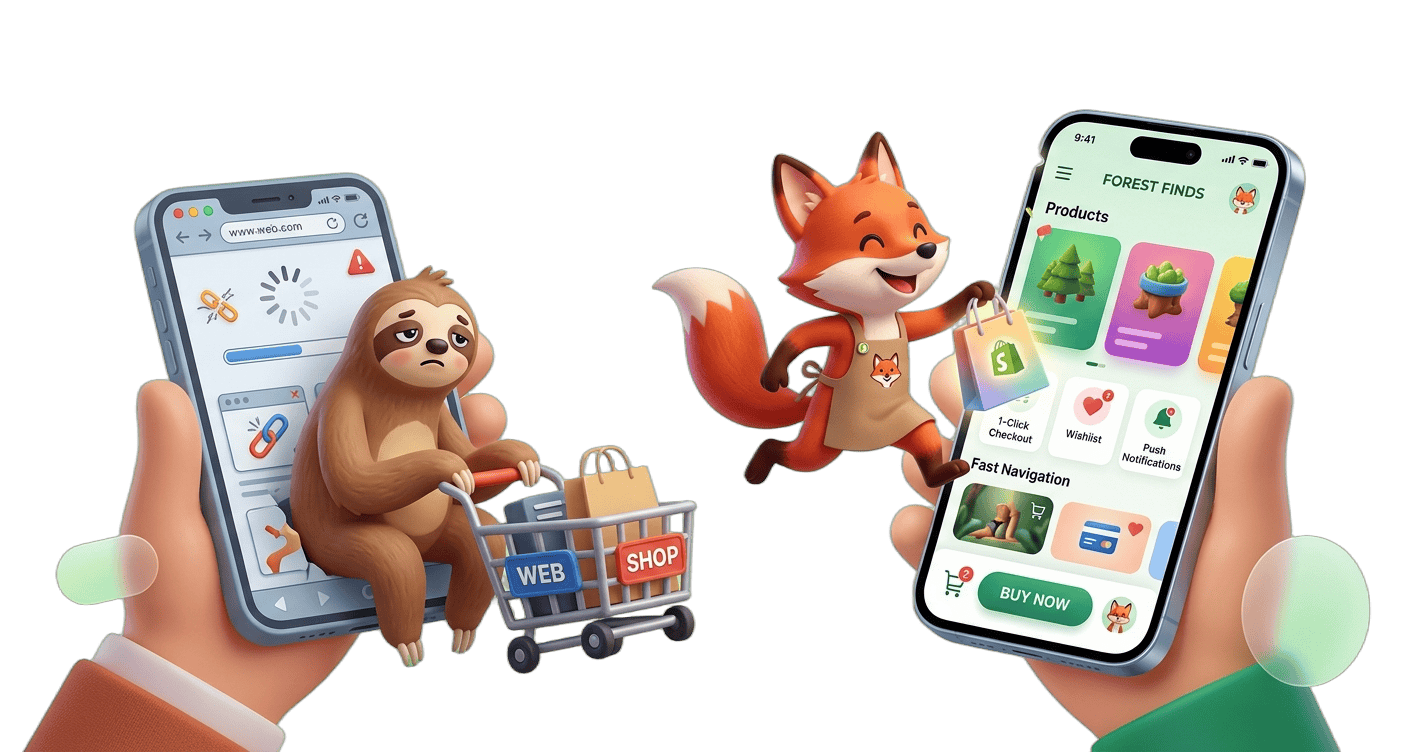
Shopify brands are increasingly shifting from mobile websites to native apps because the numbers behind retention and conversion are hard to ignore.
Across ecommerce, repeat purchase rates from app users are consistently higher than mobile web users, largely because apps remove friction at checkout and keep customers continuously engaged through push notifications and personalized experiences.
Native apps typically see stronger session frequency, longer engagement time, and higher average order value compared to mobile browsers.
Instead of relying on users to “come back” through ads or search, brands gain a direct channel to re-engage customers instantly and consistently.
As customer acquisition costs continue to rise, Shopify brands are prioritizing channels that maximize lifetime value rather than one-time purchases.
Native mobile apps are becoming that channel, turning passive mobile traffic into owned, high-retention customer relationships.
Reduce app bloat and improve mobile shopping performance without coding- Join AppNatively Waitlist
What Is a Native Mobile App?
A native mobile app is a type of application that is built specifically for a particular mobile operating system, such as Android or iOS.
What makes it “native”?
It’s written using programming languages and tools that are officially supported by that platform:
- For Android → languages like Java or Kotlin
- For iOS → languages like Swift or Objective-C
Key characteristics
- Optimized performance: Runs fast because it’s designed for that specific system
- Full device access: Can use features like the camera, GPS, microphone, and notifications
- Better user experience: Follows the platform’s design guidelines (so it feels “natural” to users)
- App store distribution: Typically downloaded from stores like the Google Play Store or Apple App Store
Simple example
Apps like Instagram or WhatsApp have native versions built separately for Android and iOS.
Native vs others (quick contrast)
- Native apps → Built for one platform (best performance)
- Web apps → Run in a browser (no installation needed)
- Hybrid apps → One codebase for multiple platforms (less optimized)
Why Shopify Brands Are Moving Beyond Mobile Websites
Many Shopify brands are moving beyond mobile websites because shoppers now expect faster, smoother, and more app-like experiences on their phones.
A mobile website is still important, but for many online stores it’s no longer enough to maximize customer engagement and sales.
Main reasons Shopify brands are making the shift
1. Better shopping experience
Native mobile apps feel faster and more responsive than mobile websites:
- Instant loading
- Smooth navigation
- Easier checkout
- Personalized experiences
This reduces friction during shopping, which can increase conversions.
2. Push notifications increase repeat sales
Websites rely mostly on email or ads to bring customers back. Mobile apps can send:
- Sale alerts
- Back-in-stock reminders
- Cart abandonment notifications
- Loyalty rewards
Push notifications often lead to higher repeat purchases because they reach users directly on their phones.
3. Faster checkout = fewer abandoned carts
Apps can store:
- Payment details
- Shipping addresses
- Preferences
That means fewer steps at checkout and fewer lost sales.
4. Stronger customer loyalty
Apps help brands create a more direct relationship with customers through:
- Rewards programs
- Exclusive app-only offers
- Personalized recommendations
- Membership features
This can make shoppers return more often instead of comparing products across many websites.
5. Better performance on mobile
A lot of e-commerce traffic now comes from smartphones. Native apps can better use phone features like:
- Camera
- Biometrics (Face ID/fingerprint login)
- Offline access
- Location services
These features are harder or more limited in standard mobile websites.
6. Reduced dependence on social media ads
As advertising costs rise on platforms like Meta Platforms and TikTok, brands want owned channels where they can reach customers directly. Mobile apps give them:
- Direct communication
- First-party customer data
- Higher retention opportunities
7. Progressive Web Apps (PWAs) and native apps are more competitive now
Some Shopify brands are also adopting:
- Progressive Web Apps (PWAs) — websites that behave more like apps
- Full native mobile apps
- Cross-platform frameworks like Flutter or React Native
These technologies have become cheaper and easier to build than before.
Who benefits most?
This trend is especially strong for:
- Fashion brands
- Beauty brands
- Fitness and wellness companies
- Subscription businesses
- Brands with loyal repeat customers
Small stores with occasional buyers may still do fine with only a mobile website.
Important point
Most Shopify brands are not replacing mobile websites completely. Instead, they’re adding:
- Native apps
- PWAs
- App-like shopping experiences
The mobile website still matters for search engines, discovery, and first-time visitors. The app is often used to improve retention and repeat purchases.
Key Benefits of Native Mobile Apps for Shopify Brands
Native mobile apps give Shopify brands a way to move beyond the limitations of mobile websites and create a more direct, high-performing shopping experience.
Instead of relying on browsers and ads alone, brands use apps to build stronger long-term relationships with customers.
i. Higher conversion rates
One of the biggest advantages is smoother purchasing. Native apps reduce friction by allowing faster browsing, saved user details, and simplified checkout flows.
When customers don’t have to repeatedly enter information or wait for pages to load, they are more likely to complete their purchases.
ii. Stronger customer retention
Apps naturally encourage repeat visits because they live on the user’s home screen. Unlike mobile websites that require search or ads to revisit, an app is always one tap away.
For Shopify brands, this helps turn one-time buyers into returning customers.
iii. Direct communication through push notifications
Native apps allow brands to reach customers instantly through push notifications. These can include sale announcements, abandoned cart reminders, restock alerts, or personalized offers.
This direct channel is often more effective than email because it appears immediately on the user’s device.
iv. Better personalization
Apps can deliver more tailored shopping experiences based on user behavior. Product recommendations, offers, and content can be adjusted to match individual preferences, making the shopping journey feel more relevant and engaging.
v. Improved performance and speed
Because native apps are built specifically for platforms like iOS and Android, they generally run faster and more smoothly than mobile websites.
This performance advantage matters a lot in e-commerce, where even small delays can reduce sales.
vi. Stronger brand presence on the device
Having an app installed creates a constant visual reminder of the brand. It increases familiarity and keeps the store present in the customer’s daily phone usage, which helps build long-term loyalty and engagement.
vii. Reduced dependence on advertising platforms
With a native app, Shopify brands are less reliant on paid channels like Meta Platforms and TikTok for re-engagement. Instead, they can communicate directly with their audience and build a stronger owned customer base.
Native Mobile Apps vs Mobile Websites
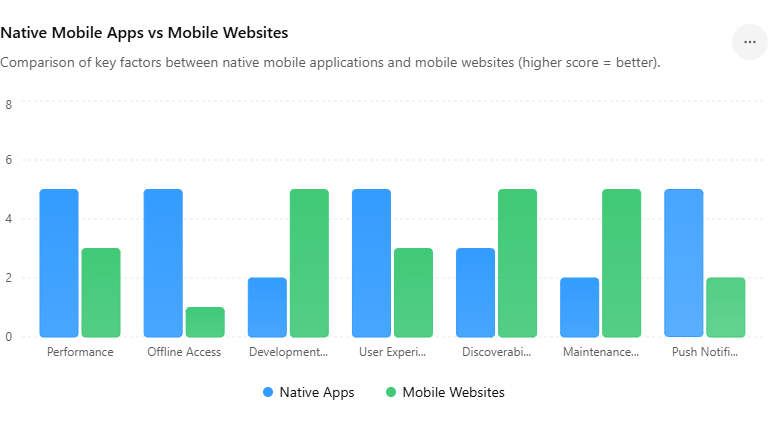
Native mobile apps and mobile websites both serve the same goal, helping users access content and shop on mobile devices, but they differ in how they are built, how they perform, and what they are best suited for, especially for Shopify brands.
1. Core difference
A native mobile app is installed directly on a device and built specifically for operating systems like iOS and Android.
A mobile website, on the other hand, runs inside a browser and is accessed through a link without installation.
2. Performance and speed
Native apps generally feel faster and more responsive because they are optimized for the device they run on. They can load content instantly, handle animations smoothly, and work better under weaker internet conditions.
Mobile websites have improved significantly, but they still depend on browser performance and network conditions, which can introduce delays.
3. User experience
Apps provide a more seamless and immersive experience. Navigation feels more fluid, and interactions are designed specifically for mobile usage patterns.
Mobile websites are easier to access but often feel more constrained because they must work across many devices and browsers.
4. Engagement and retention
Native apps have a major advantage in keeping users engaged. Since they are installed on the home screen, users are more likely to return. Features like push notifications also help bring users back regularly.
While mobile websites rely more on search engines, ads, or links to drive repeat visits.
5. Features and device access
Apps can use built-in phone capabilities such as biometrics, camera access, location services, and offline functionality.
Mobile websites can access some of these features, but usually in a more limited or inconsistent way, depending on the browser.
6. Discoverability and accessibility
Mobile websites win when it comes to discovery. They are indexed by search engines, easy to share via links, and require no installation.
Apps require users to download them, which adds friction but often leads to more committed users once installed.
7. Maintenance and cost
Mobile websites are generally cheaper and easier to maintain because one version works across all devices.
Native apps require separate development for iOS and Android, which can increase cost and complexity.
8. When each works best
Mobile websites are ideal for attracting new customers, SEO traffic, and quick browsing without commitment.
Native apps work best for brands focused on repeat customers, loyalty programs, and higher lifetime value—common goals for growing Shopify stores.
Features Shopify Brands Love in Native Mobile Apps
Native mobile apps give Shopify brands a way to turn one-time shoppers into repeat customers by creating a more direct and engaging shopping experience.
Push notifications that drive repeat sales
Native Shopify apps let brands communicate directly with customers through push notifications. These are used for back-in-stock alerts, flash sales, cart reminders, and personalized recommendations.
Unlike email, they feel immediate and tend to get higher engagement, especially for time-sensitive offers.
Faster checkout that removes friction
One of the biggest advantages of native apps is a smoother checkout flow. Customers can use saved payment methods like Apple Pay or Google Pay, skip repeated form filling, and complete purchases in just a few taps.
This reduction in friction often translates directly into higher conversion rates.
Personalized shopping experiences
Apps make it easier to tailor the storefront to each user. Brands can show personalized home screens, recommend products based on browsing history, and highlight collections that match individual preferences.
Over time, this creates a more “curated” shopping experience that feels less generic than a standard website.
Loyalty programs that feel more engaging
Instead of hiding loyalty systems in email or web dashboards, apps bring them directly into the shopping experience.
Customers can see points, unlock VIP tiers, claim rewards, and access referral bonuses in real time. This visibility helps increase repeat purchases and long-term retention.
Exclusive drops and member-only access
Many Shopify brands use apps to create exclusivity. App users may get early access to product drops, app-only discounts, or limited-edition releases.
This creates urgency and gives customers a reason to install and keep the app.
In-app engagement and support tools
Native apps allow richer interaction beyond just browsing and buying. Customers can track orders, save wishlists, read reviews, and even chat with support without leaving the app. This keeps users inside the brand ecosystem for longer sessions.
Faster browsing and better performance
Because apps can cache content locally, product browsing often feels faster and smoother than the mobile web.
This is especially useful for image-heavy categories like fashion, beauty, and home goods, where load speed strongly affects user experience.
Stronger brand presence on the customer’s phone
An app icon on a home screen is powerful branding in itself. It keeps the brand top-of-mind, encourages repeat visits, and reduces dependence on paid ads or search traffic over time.
“Build your app instantly with drag & drop”
Common Concerns About Shopify Native Apps
Shopify brands often see strong upside in native apps, but the decision usually comes with a set of practical concerns around cost, complexity, and long-term value.
Understanding these helps teams decide whether an app is truly worth the investment.
1. High development and maintenance costs
One of the biggest concerns is the upfront and ongoing cost. Building a native app requires design, development, and integration work beyond a standard Shopify store.
On top of that, brands must budget for maintenance, updates, and OS compatibility over time.
2. Uncertainty around ROI
Many brands worry whether the app will generate enough incremental revenue to justify the investment. If customer retention is low or repeat purchase cycles are long, it can take time to see meaningful returns compared to web-only strategies.
3. App install friction
Unlike a website, an app requires users to take an extra step—downloading and installing it. Brands often struggle with convincing first-time visitors to make that commitment unless there’s a strong incentive like exclusive deals or loyalty rewards.
4. Ongoing user acquisition effort
An app doesn’t grow on its own. Brands need to actively promote installs through email, SMS, web banners, and ads. Without a strong acquisition funnel, even a well-built app can end up underused.
5. Platform restrictions and App Store dependencies
Publishing on iOS and Android means following Apple and Google guidelines. This can introduce limitations around design, payments, and updates.
App store approval processes can also slow down releases compared to web changes.
6. Technical complexity with Shopify integrations
While Shopify provides APIs, syncing product catalogs, inventory, customer data, and checkout flows in real time can still be technically complex.
This is especially true for brands using multiple third-party apps or custom backend logic.
7. Risk of low engagement after install
Getting installs is only the first step. Many brands face the issue of users downloading the app once and never returning.
Without strong retention features like push notifications or loyalty programs, engagement can drop quickly.
8. Added operational overhead for teams
Managing a mobile app adds another layer to marketing and product operations. Teams need to coordinate app-specific campaigns, analytics, UX improvements, and release cycles alongside the main Shopify store.
Turn Your Shopify Store Into a Lightning-Fast Mobile App With AppNatively
As Shopify brands grow, so does the number of apps running behind the scenes.
What starts with a few useful tools quickly turns into app bloat — heavy scripts, slower storefronts, poor mobile Core Web Vitals, frustrating checkout experiences, and declining conversions.
Many merchants are forced to choose between adding features and maintaining store speed.
We believe Shopify brands shouldn’t have to make that tradeoff.
That’s why we’re building AppNatively — an affordable drag-and-drop no-code Shopify app builder powered by AI, designed to help merchants create lightning-fast native mobile apps without developers, complex coding, or performance-heavy storefront customizations.
Instead of relying entirely on dozens of storefront apps that slow down your website, AppNatively gives brands a faster, smoother, mobile-first shopping experience built specifically for modern ecommerce customers.
Why We’re Building AppNatively
Most Shopify mobile experiences still depend heavily on browsers and third-party apps. Over time, that creates:
- Slow-loading mobile pages
- Poor customer experience
- Lower conversion rates
- High mobile bounce rates
- Frustration managing multiple apps
- Performance issues caused by excessive scripts and code injection
AppNatively is being built to solve these problems.
Our goal is simple: help Shopify merchants launch high-performance native mobile apps that improve customer experience without adding more storefront complexity.
What AppNatively Will Help You Do
Build Native Shopify Mobile Apps Without Coding
No developers. No complicated setup. No expensive custom mobile app projects.
AppNatively’s drag-and-drop builder will make it easy to visually create and customize your Shopify mobile app.
Create Faster Mobile Shopping Experiences
Native apps are naturally faster and smoother than traditional mobile websites. With AppNatively, brands will be able to deliver:
- Faster browsing
- Better mobile navigation
- Streamlined checkout experiences
- Improved shopping retention
- Higher mobile engagement
Reduce Dependence on Bloated Storefront Apps
Instead of continuously adding more apps and scripts to your Shopify storefront, AppNatively helps brands create a dedicated mobile experience optimized for performance and conversions.
Use AI to Simplify App Creation
We’re building AI-powered workflows to help merchants launch apps faster and make mobile app creation more accessible for growing ecommerce brands.
Join the AppNatively Waitlist
AppNatively is currently in development, and we’re opening early access soon.
If you’re a Shopify merchant frustrated with slow storefronts, app overload, and poor mobile experiences, join the waitlist to get early access, product updates, and launch announcements.
Be among the first brands to experience a faster, simpler way to build native Shopify mobile apps — without sacrificing performance.