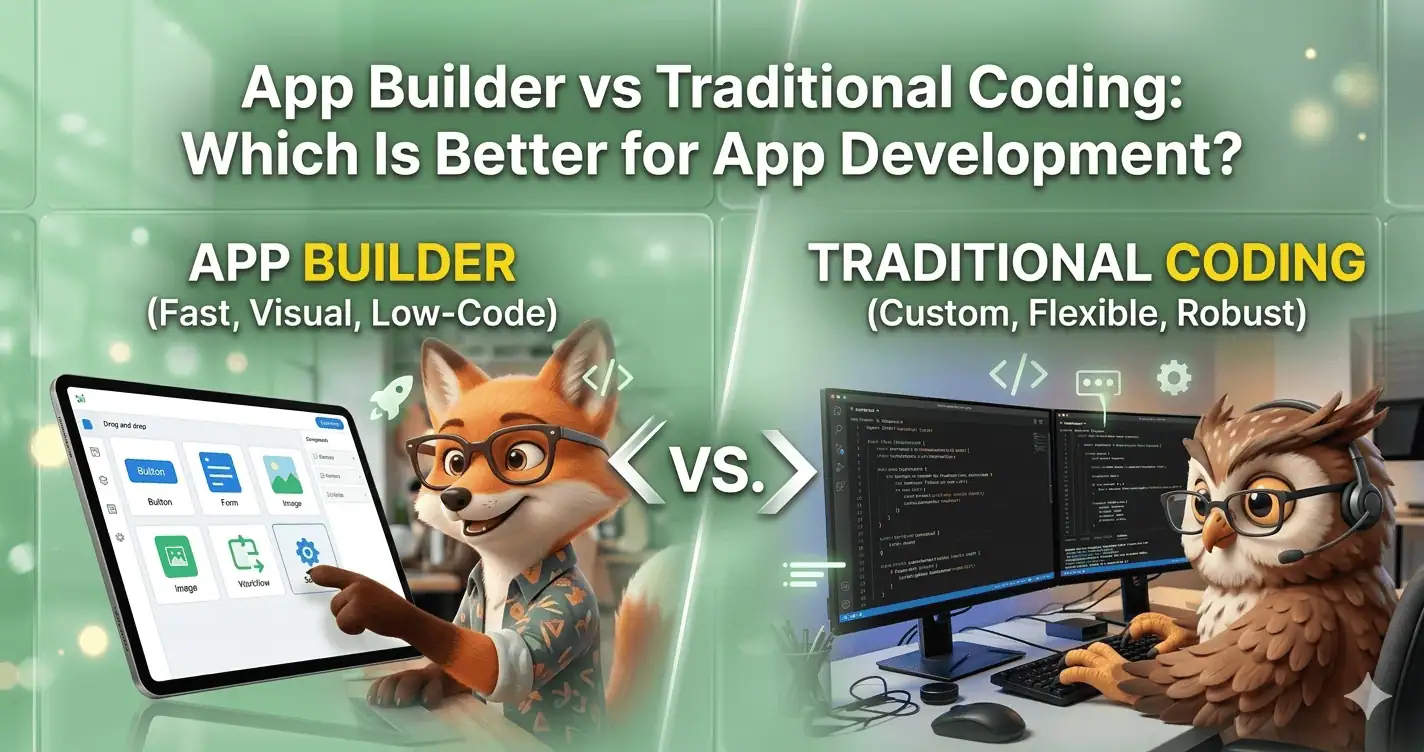
The debate between app builder vs traditional coding has become increasingly important as businesses look for faster and more cost-effective ways to build applications.
App builders allow users to create mobile or web apps using visual interfaces, drag-and-drop components, and minimal coding knowledge.
Traditional coding, however, requires developers to write custom code using programming languages such as JavaScript, Swift, or Kotlin.
Both approaches have distinct advantages. No-code and low-code app builders help startups launch apps faster and reduce development costs, while traditional coding offers full customization, scalability, and control over the application architecture.
The right choice depends on your budget, project complexity, development timeline, and technical expertise.
Understanding the pros and cons of app builders vs traditional coding can help businesses choose the best approach for building scalable and efficient applications.
What Is an App Builder in Modern App Development?
An app builder is a platform that allows users to build apps without coding by using visual development tools.
These platforms typically include drag-and-drop interfaces, pre-built templates, database integrations, and automation features.
The rise of no code app development tools has made it possible for entrepreneurs, marketers, and small businesses to build applications without hiring large development teams.
By simplifying the technical process, app builders help companies launch products faster and experiment with ideas more efficiently.
Modern no-code app development platforms can even generate native mobile apps for Android and iOS, making them a powerful alternative to traditional development.
What Is Traditional Coding in App Development?
Traditional coding refers to building applications by writing code manually using programming languages and development frameworks.
Developers create both the frontend and backend of the application using tools such as React, Flutter, Swift, Kotlin, and Node.js.
This approach allows for custom app development, where every element of the application can be designed according to specific requirements.
Businesses that need unique workflows, high performance, or advanced integrations often rely on traditional coding to achieve complete control over the product.
Although this method offers maximum flexibility, it usually requires experienced developers and longer development cycles.
App Builder vs Traditional Coding: Key Differences
| Feature | App Builder | Traditional Coding |
|---|---|---|
| Development Speed | Very fast | Slower |
| Technical Skills | Minimal | Advanced programming required |
| Cost | Lower | Higher |
| Customization | Limited to platform features | Fully customizable |
| Scalability | Moderate | High |
| Ownership | Platform dependent | Full ownership |
This comparison highlights why no code vs traditional development has become a major discussion in the app development industry.
Pros of App Builders
i. Faster Time to Market
One of the biggest app builder advantages is the ability to launch applications quickly. Instead of building everything from scratch, users can assemble apps using ready-made components and integrations.
This allows startups to test ideas quickly and release products in weeks instead of months.
ii. Lower Development Costs
App builders significantly reduce development expenses. Businesses can build apps without hiring large development teams, which makes app development without coding accessible to smaller organizations.
Many platforms offer affordable monthly plans that replace expensive development contracts.
iii. Accessibility for Non-Developers
With visual development tools, even non-technical founders can create functional applications.
This democratization of technology has helped many startups build digital products without relying heavily on engineers.
Cons of App Builders
i. Limited Flexibility
Although modern app builders offer many features, they may not support extremely complex workflows or unique product requirements.
Companies that require specialized functionality may eventually need custom development.
ii. Platform Dependency
Using an app builder often means relying on the platform’s infrastructure, which can limit portability and control over the application.
Pros of Traditional Coding
1. Complete customization
One of the biggest traditional coding benefits is the ability to build applications exactly as required.
Developers can create custom features, unique user experiences, and specialized integrations.
2. High Scalability
Applications built through traditional coding can scale more efficiently because developers control the architecture and infrastructure.
This is particularly important for large SaaS platforms or enterprise-level software.
Cons of Traditional Coding
Higher Costs
Custom development requires skilled engineers, designers, and infrastructure resources. This makes traditional coding significantly more expensive than no-code development.
Longer Development Timeline
Building an app from scratch takes time. Development, testing, debugging, and deployment can take several months before the product becomes market ready.
App Builder vs Traditional Coding: Real Cost Breakdown (2026)
One of the biggest factors when choosing between app builders and traditional coding is development cost.
Businesses and startups often struggle to estimate how much it actually costs to build an app using different development methods.
Understanding the true cost difference between no-code app builders and traditional development can help companies choose the most practical solution for their project.
Cost of building an app with an App Builder
Modern no-code app builders dramatically reduce development costs because they eliminate the need for large engineering teams.
Instead of building infrastructure and code from scratch, users assemble apps using pre-built components and visual interfaces.
For most startups, the cost of using an app builder typically ranges between $20 and $200 per month, depending on the platform and features included.
Because development happens much faster, businesses can launch apps in weeks instead of months. This also reduces opportunity cost and allows teams to test their ideas earlier.
Cost of traditional App development
Traditional coding is significantly more expensive because it involves hiring developers, designers, testers, and sometimes DevOps engineers.
The total cost can vary depending on app complexity, platform requirements, and development timeline.
A basic mobile application built through traditional coding can cost anywhere between $20,000 and $80,000.
More complex apps with advanced integrations, custom backend systems, and scalability requirements can easily exceed $150,000 or more.
Additionally, companies must consider ongoing costs such as server infrastructure, maintenance, updates, and security management.
App Builder vs Traditional Coding Cost Comparison
| Factor | App Builder | Traditional Coding |
|---|---|---|
| Initial Cost | Very Low | High |
| Development Time | Weeks | Months |
| Maintenance | Mostly handled by platform | Managed by development team |
| Infrastructure | Included in platform | Requires custom setup |
| Scaling Cost | Predictable subscription | Increasing engineering cost |
This comparison shows why many startups now prefer no-code app development platforms for launching MVPs and early-stage products.
Which Option Is More Cost-Effective?
For early-stage startups and entrepreneurs, app builders are usually the most cost-effective option. They allow businesses to launch products quickly, validate ideas, and avoid large upfront investments.
However, companies building highly customized platforms or enterprise-grade software may eventually require traditional coding to achieve deeper flexibility and advanced scalability.
In many cases, successful companies start with no-code app builders to validate their product and later transition to custom development as their business grows.
When Should You Choose an App Builder?
App builders are ideal for startups, entrepreneurs, and businesses that want to launch apps quickly with limited budgets.
They are particularly useful for:
- MVP development
- business tools
- marketplace apps
- booking systems
- content apps
If speed and affordability are top priorities, no code app development can be the best option.
When Should You Choose Traditional Coding?
Traditional coding is best suited for complex products that require advanced features, high scalability, and full control over the application infrastructure.
Large SaaS platforms, enterprise software, and advanced mobile applications typically rely on traditional development.
The Future of No-Code vs Traditional Development
The rise of native app builder platforms is changing how businesses approach software development.
Many modern tools now allow users to build fully functional mobile apps without extensive coding.
However, traditional coding will continue to play an important role in building highly customized and performance-driven applications.
The future of app development will likely involve a hybrid approach that combines visual app development platforms with custom coding capabilities.
The Benefits of Modern App Development
Here are the aspects of modern app development that you, as a smart user, should know about.
1. Developer productivity and workflow
One major advantage of modern app development platforms is improved developer productivity.
Visual development environments reduce repetitive coding tasks, allowing teams to focus on building product features instead of writing boilerplate code.
Traditional coding still provides more control, but it often requires managing complex development environments, frameworks, and dependencies.
2. Maintenance and long-term updates
Maintenance is another critical factor when choosing between no-code app development and traditional coding. App builders often handle updates, security patches, and infrastructure management automatically.
With traditional development, companies must maintain servers, update frameworks, and manage security vulnerabilities themselves.
3. Integration ecosystems
Modern businesses rely heavily on integrations with CRM systems, payment gateways, analytics tools, and marketing platforms.
Many modern app builders and native app builder platforms provide pre-built integrations that simplify connecting with external services.
Traditional coding can achieve the same results but usually requires building custom APIs and integrations manually.
4. Speed of experimentation
Startups often need to test multiple ideas quickly. App builders enable rapid experimentation by allowing teams to launch prototypes or MVPs without investing months into development.
This makes no-code development particularly valuable for early-stage startups and product validation.
Why Modern Startups Prefer AI-Powered App Builders Like App Natively
As the demand for faster product launches continues to grow, many startups are turning toward AI-powered app builders that combine simplicity with powerful development capabilities.
Instead of spending months building apps through traditional coding, founders can now design and launch mobile applications using intelligent visual tools that automate much of the development process.
Modern platforms are evolving beyond basic no-code builders. With the help of AI, these tools can now assist with layout creation, workflow automation, and feature configuration, making it possible to generate fully functional native mobile apps with minimal technical effort.
One example of this next generation of tools is App Natively. It is an AI-powered no-code native app builder currently under development, designed to help entrepreneurs, startups, and creators build professional mobile apps without writing code.
Instead of requiring deep programming knowledge, users can visually design their apps while AI helps streamline the development process.
For early-stage startups and founders, this approach offers several key advantages.
1. Faster product launches
Speed is critical for startups. With AI-assisted no-code development, founders can design and launch mobile apps significantly faster than traditional coding cycles that often take months.
This allows teams to validate ideas quickly and reach users earlier.
2. Lower development costs
Traditional app development often requires hiring multiple developers, designers, and infrastructure specialists.
With AI-powered no-code platforms, startups can dramatically reduce development costs and invest more resources into marketing, growth, and product improvement.
3. Accessible app development
AI-driven visual builders make app creation accessible to entrepreneurs, creators, and small businesses.
Instead of depending entirely on engineering teams, founders can build and iterate on their apps themselves.
4. Built for native mobile apps
Unlike many traditional no-code tools that create web apps or hybrid apps, platforms like App Natively focus on generating real native mobile apps, giving users better performance and user experience.
5. Built for affordability
One of the key goals behind App Natively is affordability. The platform aims to offer one of the most accessible pricing models in the no-code app builder market, including a free version so that creators and startups can start building without financial barriers.
Join the App Natively Waitlist
App Natively is currently under development, and early users now have the opportunity to join the exclusive waitlist.
By joining the waitlist, you can:
- Get early access to the platform
- Try the free version when it launches
- Be among the first to build AI-powered native mobile apps without coding
If you’re a startup founder, entrepreneur, or creator looking to build your own app faster and more affordably, joining the App Natively waitlist is the best way to stay ahead of the next wave of app development.
Conclusion
Choosing between app builder vs traditional coding depends on your project goals, technical requirements, and available resources.
App builders offer speed, affordability, and accessibility, making them perfect for startups and rapid product launches.
Traditional coding, on the other hand, provides full flexibility and scalability for complex applications.
By understanding the strengths of both approaches, businesses can choose the development strategy that best supports their growth and innovation.
Frequently Asked Questions (FAQs)
Is no-code better than traditional coding?
No-code platforms are better for speed, affordability, and accessibility. Traditional coding is better for complex and highly customized applications.
Can you build professional apps without coding?
Yes. Many modern app builders allow users to create professional mobile and web applications without writing code.
Are no-code apps scalable?
No-code apps can scale for many use cases, but extremely complex or high-traffic applications may require custom development.
Do companies use no-code platforms?
Yes. Many startups and businesses use no-code tools to build MVPs, internal tools, and customer-facing applications.
Why startups prefer no-code app builders?
Many startups prefer no-code app builders because they significantly reduce development time and cost.
Instead of hiring large engineering teams, founders can build MVPs quickly, test their ideas, and launch products faster using visual development platforms.
How long does it take to build an app?
The time required to build an app depends on the development method. Using an app builder, a basic application can be created in a few days or weeks.
With traditional coding, development may take several months due to custom programming, testing, and deployment.