
Traditional app development is expensive, time-consuming, and heavily dependent on skilled developers.
For startups and businesses, this creates a major bottleneck—ideas sit idle while competitors move faster.
What if you could turn your idea into a working app in days instead of months? What if your marketing team, founder, or operations manager could build tools without writing a single line of code?
No-code platforms are removing the biggest barrier in tech, coding. With drag-and-drop builders, automation, and AI integration, anyone can now create powerful applications without technical expertise.
👉 Join the waitlist for App Natively and be among the first to build AI-powered apps without code.
Why 90% of Apps Will Be Built Without Code by 2027
1. The developer shortage is accelerating the shift
The demand for software is growing faster than the supply of developers.
Companies are struggling to hire and retain engineering talent, which makes no-code platforms a practical alternative.
Businesses can’t afford to wait—they need solutions now.
2. AI is making no-code even more powerful
AI is supercharging no-code platforms by enabling automation, smart workflows, and even app generation from simple prompts.
This combination drastically reduces the need for manual coding while increasing output.
3. Speed is the new competitive advantage
In today’s market, the fastest builder wins. No-code tools allow teams to launch MVPs in days, validate ideas quickly, and iterate based on user feedback, something traditional development struggles to match.
4. Cost efficiency is driving adoption
Hiring developers, maintaining infrastructure, and managing long development cycles are expensive.
No-code reduces these costs significantly, making app development accessible to startups and small businesses.
5. The rise of citizen developers
Non-technical users like marketers, founders, and product managers are now building applications themselves.
This shift is redefining who can create software and how innovation happens.
What Types of Apps Will Be Built Without Code
i. Startups and MVPs
Founders are increasingly using no-code to validate ideas quickly before investing in full-scale development.
ii. Internal business tools
Companies are building dashboards, CRMs, and automation tools without relying on engineering teams.
iii. Marketplaces and SaaS products
No-code platforms now support complex applications, including multi-vendor marketplaces and subscription-based SaaS tools.
iv. Mobile apps
With the rise of AI-powered builders, native mobile apps are becoming easier to create without coding knowledge.
Why You Should Care Right Now
Early adopters will win big
Just like early adopters of social media and SEO dominated their industries, early no-code adopters will gain a massive competitive advantage.
The barrier to entry is disappearing
You no longer need a technical background to build software. Ideas and execution matter more than coding skills.
The market will get crowded
As more people adopt no-code, competition will increase. Getting in early is the key to standing out.
No-Code vs Traditional Development (Comparison Chart)
| Factor | No-Code Development | Traditional Development |
|---|---|---|
| Speed of Development | Extremely fast — apps can be built in days or weeks | Slower — typically takes months to develop and launch |
| Technical Skills Required | No coding skills needed — beginner-friendly | Requires experienced developers and coding expertise |
| Cost | Low cost — minimal development and maintenance expenses | High cost — developer salaries, infrastructure, ongoing maintenance |
| Flexibility & Customization | Limited to platform capabilities and integrations | Fully customizable — complete control over features and logic |
| Scalability | Improving rapidly — suitable for most startups and SMEs | Highly scalable — ideal for complex, enterprise-level systems |
| Maintenance | Handled by the platform — minimal effort required | Requires continuous updates, bug fixes, and DevOps support |
| Time to Market | Very fast — launch MVPs quickly | Slow — longer testing and development cycles |
| Security | Managed by platform providers — generally secure | Fully controlled — depends on development practices |
| Integration Capabilities | Easy integrations via APIs and plugins | Fully flexible but requires manual implementation |
| Ownership & Control | Platform-dependent — limited backend access | Full ownership of code and infrastructure |
| Learning Curve | Very low — intuitive drag-and-drop interfaces | High — requires programming knowledge and experience |
| Best For | Startups, MVPs, internal tools, rapid prototyping | Large-scale apps, complex systems, custom solutions |
Build Smarter, Launch Faster with App Natively
What if you could turn your idea into a fully functional, native app without writing a single line of code, hiring expensive developers, or waiting months to launch?
That’s exactly what App Natively is built for.
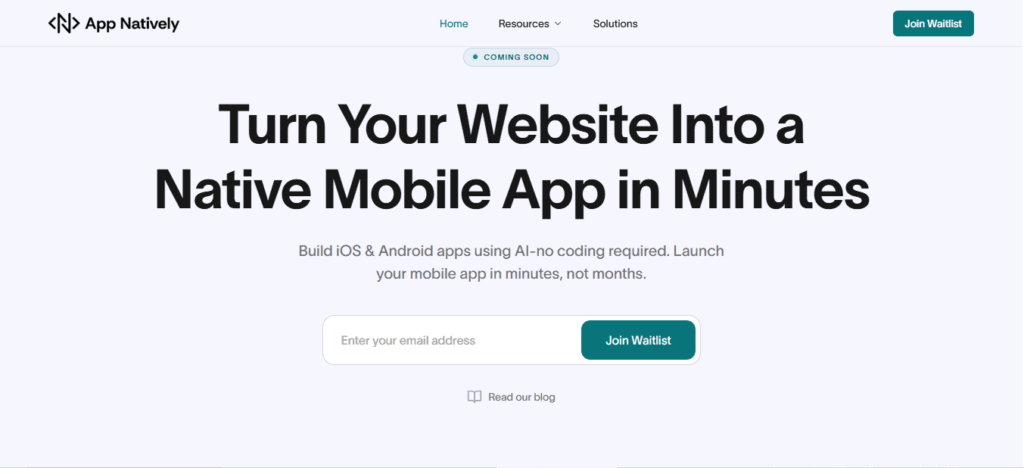
Designed for founders, marketers, creators, and agencies, App Natively is an AI-powered no-code platform that eliminates the biggest bottlenecks in app development.
Instead of struggling with complexity, you simply describe what you want and the platform helps you bring it to life faster than ever before.
Imagine launching your MVP in days. Imagine testing ideas instantly. Imagine owning your product without technical dependency. This is not just convenience—it’s a competitive advantage.
The future of app development is not coding. It’s creation without friction. And early adopters always win.
Right now, while others are still stuck in slow development cycles, you have the opportunity to get ahead before the market becomes crowded.
👉 Join the App Natively waitlist today and secure your early access to the next generation of app building.
Frequently Asked Questions (FAQs)
What is no-code app development?
No-code app development allows users to build applications using visual interfaces and drag-and-drop tools without writing code.
Will no-code replace developers?
No, but it will reduce the need for developers in many projects. Developers will focus more on complex and scalable systems.
Is no-code scalable for large applications?
Modern no-code platforms are increasingly scalable and can handle complex applications, especially when combined with APIs and integrations.
How fast can you build an app with no-code?
Depending on complexity, apps can be built in days or weeks instead of months.
Are no-code apps secure?
Most reputable no-code platforms offer strong security measures, including data encryption and compliance standards.
What is the future of no-code development?
No-code is expected to dominate app development by 2027, making software creation accessible to millions of non-developers worldwide.
Leave a Reply